Since most people (over 60%) voted to treat this as torsade, it’s worth clarifying why this is actually artifact rather than a true arrhythmia. The strip mimics polymorphic VT, but several key features are missing:
Lack of typical initiation pattern
At the red arrow in the above image, you can see the beat just before the “tachycardia” starts. Torsade almost always begins after a pause (pause-dependent) or on the background of bradycardia.
Here, there is no preceding pause or classic “short–long–short” sequence that would set up torsade.
No QT prolongation
For torsade to occur, there should be baseline QT prolongation—at least in the initiating beat, if not throughout.
The beats leading into this episode do not show prolonged repolarization.
✅ Teaching point:
Because artifact can mimic polymorphic VT, many clinicians may mistake it for torsade. Recognizing the absence of QT prolongation and the lack of pause-dependent initiation at the red arrow is key.
📌 One-liner takeaway:
If there’s no pause and no QT prolongation at initiation (red arrow), it’s likely not torsade.


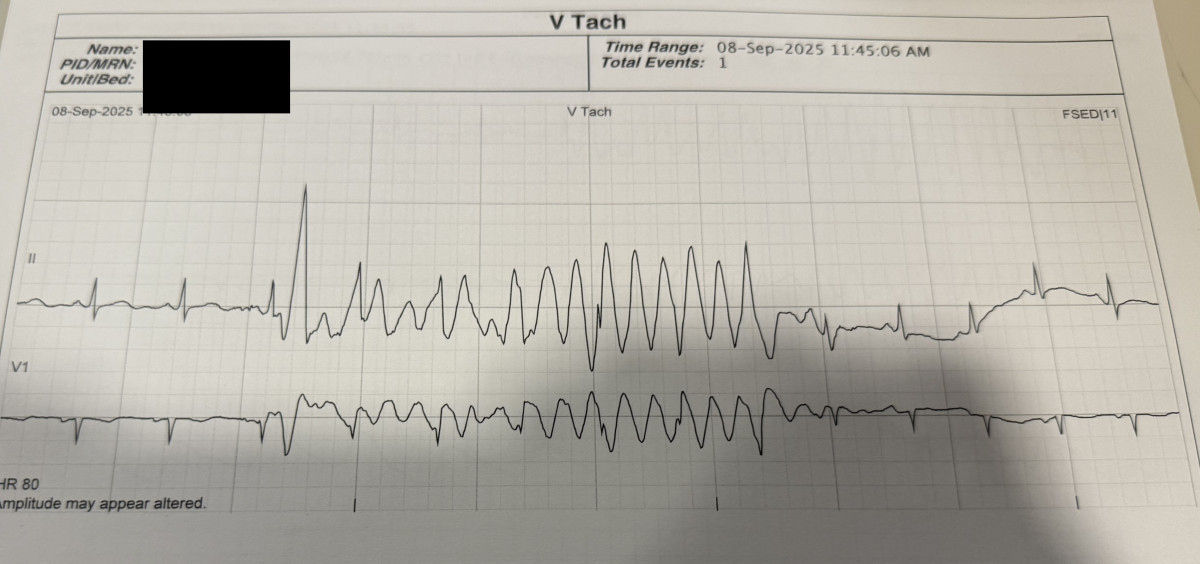
Correct answer is A. Explanation in video below.
Why this tracing is not Torsade de Pointes
Since most people (over 60%) voted to treat this as torsade, it’s worth clarifying why this is actually artifact rather than a true arrhythmia. The strip mimics polymorphic VT, but several key features are missing:
✅ Teaching point:
Because artifact can mimic polymorphic VT, many clinicians may mistake it for torsade. Recognizing the absence of QT prolongation and the lack of pause-dependent initiation at the red arrow is key.
📌 One-liner takeaway:
If there’s no pause and no QT prolongation at initiation (red arrow), it’s likely not torsade.